



Introduction
Acne vulgaris is an ongoing, multifactorial inflammatory disorder of the pilosebaceous unit, predominantly impacting teenagers and young adults, however it may continue into later life stages [1]. It is clinically defined by a range of lesions, encompassing open and closed comedones, inflammatory papules, pustules, nodules, and cysts, primarily located on the face, chest, and back. Acne, with a global incidence affecting approximately 80–90% of teenagers, constitutes a major public health issue and significantly contributes to dermatological morbidity globally [2]. The pathophysiology of acne vulgaris is intricate and encompasses four principal processes: heightened sebum production induced by androgens, aberrant follicular keratinization resulting in comedone formation, colonization of the pilosebaceous unit by Cuti bacterium acnes, and ensuing inflammatory responses facilitated by both innate and adaptive immune mechanisms [3]. Recent advancements have underscored the significance of genetic predisposition, hormonal variations, and modifications in the skin microbiome in affecting disease susceptibility and severity [4]. Moreover, recent evidence indicates that systemic variables, like insulin resistance and high glycemic load diets, may intensify acne via hormonal and inflammatory mechanisms. Alongside biological variables, lifestyle and environmental factors have garnered heightened focus in recent years [5]. Psychological stress has been demonstrated to aggravate acne through neuroendocrine pathways, specifically via the hypothalamic–pituitary–adrenal (HPA) axis, which can elevate sebum production and inflammatory reactions [6].
Likewise, dietary patterns—particularly elevated consumption of dairy products, fast foods, and high-glycemic-index diets—have been correlated with acne severity in numerous epidemiological studies. Sleep deprivation, sedentary behavior, and improper cosmetic application exacerbate acne, especially in university students who frequently endure erratic schedules and academic pressure [7]. Aside from its physical manifestations, acne vulgaris has significant psychosocial consequences. It has been persistently linked to diminished self-esteem, social withdrawal, anxiety, and depression, consequently substantially reducing quality of life. The psychological impact of acne can, in certain instances, be akin to that of chronic systemic diseases, highlighting the necessity for holistic management strategies that encompass both physical and mental health dimensions [8].
Despite the wide global literature on acne, there is a scarcity of region-specific data in developing nations, like Pakistan, where social, nutritional, and environmental factors may significantly differ from those in Western populations. University students constitute a notably susceptible demographic owing to heightened stress exposure, nutritional inconsistencies, and lifestyle alterations [9]. Nevertheless, few research have investigated the synergistic impact of these modifiable risk variables within this demographic. This study is to evaluate the prevalence of acne vulgaris and determine its associated lifestyle and behavioral risk factors among university students. This study aims to enhance the existing knowledge base by offering localized evidence and to aid in the formulation of tailored preventative strategies and educational interventions to alleviate the prevalence of acne among young adults.
Methodology
Study Design and Setting
A cross-sectional analytical investigation was performed during three months (January to March 2026) at a university campus in Pakistan. The study aimed to evaluate the prevalence of acne vulgaris and identify related lifestyle risk factors among university students.
Study Population and Sampling
The study population consisted of undergraduate and postgraduate students aged 18 to 30 years. A sample size of 250 individuals was determined utilizing standard prevalence estimation techniques, with a confidence level of 95%, a margin of error of 5%, and an anticipated prevalence of 50% owing to insufficient prior regional data. Participants were selected through a non-probability convenience sampling method from several academic fields.
Inclusion and Exclusion Criteria
Participants aged 18 to 30 years who consented to participate were included in the study. Individuals with chronic dermatological problems excluding acne (e.g., eczema, psoriasis), those undergoing systemic treatment for acne (e.g., isotretinoin, oral antibiotics), and those with recognized endocrine abnormalities impacting skin health were excluded to prevent confounding effects.
Data Collection Procedure
Data were gathered with a standardized, self-administered questionnaire created following an extensive examination of pertinent literature. The questionnaire comprised several sections, encompassing demographic variables (age, gender, academic year), lifestyle factors (dietary habits, sleep length, physical activity), psychological stress levels, and skincare practices (cosmetic usage, frequency of face washing, types of products). Stress levels were evaluated with a validated perceived stress scale or a Likert-type assessment. Before data collection, the questionnaire underwent pilot testing with a small cohort of students (n=20) to ascertain clarity and reliability.
Clinical Assessment
Participants underwent clinical assessment for the existence and severity of acne vulgaris. The diagnosis was established according to standard dermatological criteria, and the severity was assessed utilizing the Global Acne Grading System (GAGS), which takes into account lesion kind and anatomical location. According to the scoring system, acne severity was classified as mild, moderate, severe, or extremely severe.
Study Variables
The dependent variable was the occurrence and intensity of acne vulgaris. The independent variables encompassed demographic parameters (age, gender), lifestyle aspects (diet, sleep length, physical activity), psychological stress, and cosmetic usage. Dietary practices primarily centered on the frequency of intake of fatty foods, dairy items, and high-glycemic-index foods.
Statistical Analysis
Data were inputted and analyzed utilizing Statistical Package for the Social Sciences (SPSS) version 25. Descriptive statistics were computed, encompassing means, standard deviations, frequencies, and percentages. The chi-square test was utilized to evaluate relationships among categorical variables, whereas independent t-tests were employed for continuous variables when applicable. A multivariate logistic regression analysis was conducted to find independent predictors of acne vulgaris, while adjusting for relevant confounders. A p-value below 0.05 was deemed statistically significant.
Ethical Considerations
Before any data was collected, written informed consent was obtained from all subjects. The people who took part were promised privacy and anonymity, and their information was only used for study. All methods were carried out according to the rules and guidelines that were in place.
Results
There were 250 college students who took part in the study, which means that 100% of them were asked to do so. They were between the ages of 18 and 30 years old, with a mean age of 21.4 ± 2.3 years. 150 of the people who took part were women (60%), and 100 were men (40%).
|
Variable |
Value |
|
Total Participants |
250 |
|
Mean Age (years) |
21.4 ± 2.3 |
|
Female (%) |
60% |
|
Male (%) |
40% |
Prevalence of Acne Vulgaris
Out of the whole group, 170 people were clinically diagnosed with acne vulgaris, giving the general prevalence of 68%. The rate was slightly higher in women (72% vs. 62%) than in men, but the difference wasn't statistically significant (p > 0.05).
|
Category |
Percentage |
|
Prevalence |
68 |
|
Mild |
40 |
|
Moderate |
35 |
|
Severe |
25 |
Severity of Acne
Using the Global Acne Grading System (GAGS), 170 people with acne were put into three groups based on how bad their acne was: 68 had mild acne (40%), 60 experienced moderate acne (35%), and 42 had serious acne (25%). The people in the study did not have any cases of very bad acne.
|
Factor |
Acne (%) |
p-value |
|
High Stress |
75 |
<0> |
|
Oily Food |
70 |
0.002 |
|
Poor Sleep |
65 |
0.005 |
|
Cosmetic Use |
72 |
0.01 |
Association with Lifestyle Factors
A study of lifestyle-related risk factors showed strong links between acne vulgaris and a number of variables that can be changed. 75% of people who said they had high levels of psychological stress had acne, compared to 55% of people who said they had low levels of stress (χ⊃2; test, p < 0>
|
Predictor |
AOR |
p-value |
|
Stress |
2.4 |
<0> |
|
Oily Food |
1.9 |
0.003 |
|
Sleep |
1.7 |
0.01 |
|
Cosmetics |
1.6 |
0.04 |
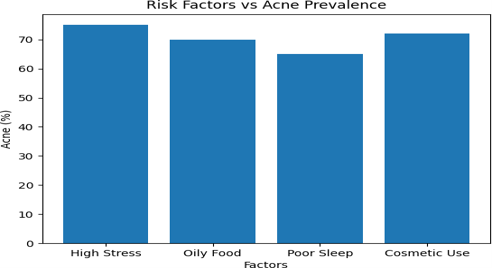
The amount of sleep also had a big effect on the amount of acne. People who said they slept less than 6 hours a night were more likely to have acne (65%) than people who said they slept 6 to 8 hours a night (52%). There was a strong link between cosmetic use and acne, especially among female subjects (72% of cosmetic users had acne compared to 58% of non-users; p = 0.01).
Multivariate Analysis
A multivariate logistic regression analysis was done to find independent indicators of acne vulgaris. AOR = 2.4 (95% CI: 1.5–3.8; p < 0 p =0.01)>
Additional Findings
There was no statistically significant link (p > 0.05) between the number of people with acne and their age or the school year. There was a weak negative relationship between physical exercise and the prevalence of acne, but it wasn't strong enough to be statistically significant (p = 0.08).
Discussion
This study looked at how common acne vulgaris is among college students and what living factors may make it worse. It found that 68% of students had acne vulgaris. There are estimates around the world that say between 80% and 90% of teens and young adults have acne. This result supports those estimates and shows that acne vulgaris is still a very common skin condition in this age group. The slightly higher prevalence seen in female participants compared to males is in line with what other studies have found. These studies show that hormonal changes, cosmetic use, and more health-seeking behavior in women may make them more vulnerable [10].
One of the most important things this study showed was that there is a strong link between mental worry and acne vulgaris. People who said they were under a lot of stress had a lot more acne, and worry also showed up as an independent predictor in multivariate analysis. This result is supported by research that shows stress can make acne worse by activating the hypothalamic–pituitary–adrenal (HPA) axis and increasing the release of cortisol and androgens. Because these changes in hormones make sebum glands work harder and cause inflammation, acne gets worse [6].
It was also discovered that what you eat has a big impact on getting acne. The study found that eating a lot of oily and fast foods was significantly linked to a higher frequency of acne. These results are in line with earlier study that suggests high-fat and high-glycemic-index diets may raise insulin and insulin-like growth factor-1 (IGF-1) levels, which then cause sebum production and keratinocyte proliferation [11]. The connection between food and acne has been debated in the past, but more and more evidence suggests that changing your diet could be a useful way to treat acne.
The amount of time spent sleeping became another important factor linked to acne vulgaris. Acne was much more common among people who said they didn't get enough sleep (less than six hours per night). Lack of sleep is known to throw off the balance of hormones, raise stress levels, and weaken the immune system. All of these things may make acne worse or cause it to appear in the first place [12]. As part of a complete plan to avoid acne, this result shows how important it is to keep good sleep hygiene.
Cosmetic use, especially among female subjects, was also strongly linked to both the number of cases and the severity of acne. When you use comedogenic or improper skin care products, they can block your pores and make acne worse. This shows that more people need to know how to choose goods that are non-comedogenic and dermatologically tested, especially those who use cosmetics a lot.
The multivariate logistic regression analysis added to these results by showing that worry, poor diet, lack of sleep, and cosmetic use are all independent predictors of acne vulgaris. These results show that acne isn't just a biological problem, but is also affected by lifestyle choices that can be changed. So, treatments that focus on these factors might help lower the number of people who get acne and make it less severe.
It's interesting that there was no significant link found between the prevalence of acne and age or school year. This means that acne affects students in this age range in a pretty uniform way. There was a weak negative relationship between physical exercise and acne, but it wasn't strong enough to be statistically significant. There could be different ways people exercise or other things that skewed the results that weren't taken into account in this study [13].
This work has some good points, like clinical assessment and multivariate analysis, but it also has some problems. It is hard to find direct links between risk factors and pimples because the study is cross-sectional. There is also a chance of selection bias when convenience sampling is used, and recall bias can happen when people describe their own lifestyle factors. Also, the study was only done at one school, which means that the results may not be applicable to other groups of people.
CONCLUSION
The results show that acne isn't just a physical problem; it's also affected by things like stress, food, sleep, and cosmetic use that can be changed. Stress was the most important indicator, followed by bad eating habits and not getting enough sleep. This shows that acne is caused by more than one thing.
These results show how important it is to take a more complete approach to treating acne, one that includes changes to your lifestyle as well as traditional drug-based treatments. A big part of lowering the number of young adults with acne could be educational programs that teach them how to deal with stress, eat well, get enough sleep, and take care of their face properly.
The study also shows how important it is to make students more aware of how their daily habits can affect their skin health. To find out what causes what and how to make targeted, evidence-based prevention and management plans, future research should focus on longitudinal and multi-center studies.
Declarations
| Ethics approval | Approved by the Institutional Ethics Committee. Research was conducted in accordance with the Declaration of Helsinki. |
| Consent to participate | Informed consent was obtained from all individual participants included in the study. |
| Funding | This research received no specific grant from any funding agency in the public, commercial, or not-for-profit sectors. |
| Conflict of interest | The authors declare that they have no competing or financial interests. |
| Data availability | The datasets generated and analyzed during the current study are available from the corresponding author upon reasonable request. |
| Author contributions | All authors contributed to the study conception, design, material preparation, data collection, and analysis. All authors read and approved the final manuscript. |
References
1.Alsaadoon, N.S.J., A.M. Al-Refaie, and A.Y. Habashy, Acne vulgaris in adolescents: A comprehensive review. Benha Journal of Applied Sciences, 2024. 9(12): p. 5-13.
2.Gugulu?, D.L., et al., The epidemiology of acne in the current era: trends and clinical implications. Cosmetics, 2025. 12(3): p. 106.
3.Akl, E.M., et al., Etiopathogenesis of acne vulgaris. Benha Journal of Applied Sciences, 2024. 9(7): p. 7-10.
4.Olceroglu, B., G. Balci, and A. Kati, The Skin Microbiome and Its Implications for Maintaining Skin Health, in Phytochemical Potentials for Dermatological Applications. 2025, CRC Press. p. 76-103.
5.Schwingshackl, L., L.P. Hobl, and G. Hoffmann, Effects of low glycaemic index/low glycaemic load vs. high glycaemic index/high glycaemic load diets on overweight/obesity and associated risk factors in children and adolescents: a systematic review and meta-analysis. Nutrition journal, 2015. 14(1): p. 87.
6.Jovi?, A., et al., The impact of psychological stress on acne. Acta Dermatovenerologica Croatica, 2017. 25(2): p. 133-133.
7.Prakesh, U. and M. Abbas, The Rising Incidence of Acne Vulgaris in Adolescents: Lifestyle Factors and Preventive Strategies in Bangladesh. Scientific Journal of Dermatology and Venereology, 2025. 3(1): p. 54-66.
8.Dunn, L.K., J.L. O'Neill, and S.R. Feldman, Acne in adolescents: Quality of life, self-esteem, mood and psychological disorders. Dermatology online journal, 2011. 17(1).
9.Mistry, D., et al., A Multisectoral Study of Mpox Epidemiology, Resistance Surveillance, and Policy Gaps: Toward a One Health Framework. Clinical Reviews in Allergy & Immunology, 2025. 68(1): p. 108.
10.Currie, D. and S. Wiesenberg, Promoting women's health-seeking behavior: research and the empowerment of women. Health care for women international, 2003. 24(10):
p. 880-899.
11.Tripathy, K., et al., Insulin Resistance, Metabolic Syndrome, and Inflammatory Skin Disease. Journal of Clinical Medicine, 2026. 15(1): p. 330.
12.Menge, J., How to Protect Your Skin from Stress & Sleep Disruption.
13.Kunin, A., The DERMAdoctor skinstruction manual: The smart guide to healthy, beautiful skin and looking good at any Age. 2007: Simon and Schuster.