
Global Journal of Urology and Kidney Research
Mechanisms of Renoprotection Induced by Omega-3 Fatty Acids: Implications for Diabetic Nephropathy, Acute and Chronic Kidney Disease Management
Research Article
View PDF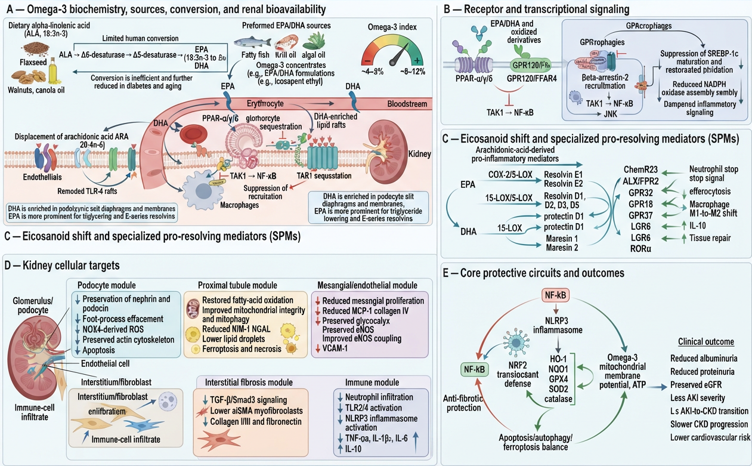
Graphical Abstract:
Mechanisms of renoprotection induced by omega-3 fatty acids: implications for diabetic nephropathy, acute kidney injury, and chronic kidney disease management. Dietary alpha-linolenic acid and preformed EPA/DHA sources contribute to systemic and renal omega-3 availability, membrane remodeling, and displacement of arachidonic acid-derived inflammatory lipid signaling. EPA- and DHA-derived metabolites generate specialized pro-resolving mediators, including E-series resolvins, D-series resolvins, protectins, and maresins, which act through defined GPCR pathways to suppress neutrophil recruitment, enhance efferocytosis, promote macrophage reprogramming, and support tissue repair. In the kidney, these actions preserve podocyte structure, improve proximal tubular mitochondrial and metabolic homeostasis, reduce mesangial and endothelial injury, and limit interstitial fibroblast activation and fibrosis. These effects converge on inhibition of NF-κB/NLRP3 signaling, activation of NRF2-dependent antioxidant defenses, preservation of mitochondrial function, and regulation of apoptosis, autophagy, and ferroptosis, thereby supporting improved renal and cardiometabolic outcomes across diabetic and non-diabetic kidney disease contexts
Abstract
Background:
Chronic kidney disease (CKD) affects >10% of adults worldwide, diabetic kidney disease (DKD) remains the leading cause of end-stage kidney disease, and acute kidney injury (AKI) complicates 10–15% of hospitalizations, often progressing to CKD. Persistent inflammation, oxidative stress, lipotoxicity, podocyte loss and tubulointerstitial fibrosis drive progression across aetiologies, yet current renin–angiotensin blockade, SGLT2 inhibitors and finerenone only partially attenuate risk. Omega-3 polyunsaturated fatty acids (n-3 PUFAs), eicosapentaenoic acid (EPA) and docosahexaenoic acid (DHA), and their specialized pro-resolving mediators (SPMs) offer multitargeted, low-toxicity renoprotection.
Objective:
This narrative review explored cellular and molecular mechanisms of omega-3-induced renoprotection and evaluates implications for diabetic nephropathy, AKI and CKD management.
Methods:
A structured narrative search of PubMed/MEDLINE, Scopus and Web of Science (2000–2026) was performed for omega-3, EPA/DHA, resolvins, protectins, maresins, DKD, AKI, CKD, proteinuria, fibrosis and clinical trials. Mechanistic, preclinical and clinical studies, meta-analyses and guidelines were critically appraised.
Results:
EPA/DHA incorporate into renal membranes, activate GPR120, PPARs and NRF2, suppress NF-κB, TLRs and NLRP3 inflammasome, attenuate SREBP-1-driven lipotoxicity, stabilize podocytes, and inhibit TGF-β/Smad fibrosis, apoptosis and ferroptosis. DHA-derived resolvins D1/D2, protectin D1 and maresin 1, and EPA-derived resolvin E1 actively resolve neutrophil/macrophage inflammation, promote M2 polarization, enhance efferocytosis and heme oxygenase-1, and reduce albuminuria, glomerulosclerosis and AKI-to-CKD transition in rodents.
Conclusion:
Omega-3 fatty acids act as nutrient-derived resolution agonists with coherent mechanistic rationale for adjunctive renoprotection. Optimizing formulation (EPA+DHA vs. pure EPA), dose, Omega-3 Index targeting and SPM-based drugs, and testing in biomarker-enriched DKD/AKI trials, are priorities.
Keywords:
Omega-3 fatty acids; EPA; DHA; Resolvins; Diabetic nephropathy; Acute kidney injury; chronic kidney disease; Glomerulosclerosis
References
- Kovesdy CP. Epidemiology of chronic kidney disease: an update 2022. Kidney Int Suppl (2011). 2022;12(1):7-11. doi:10.1016/j.kisu.2021.11.003
- Alicic RZ, Rooney MT, Tuttle KR. Diabetic kidney disease: challenges, progress, and possibilities. Clin J Am Soc Nephrol. 2017;12(12):2032-2045. doi:10.2215/CJN.11491116
- Bellomo R, Kellum JA, Ronco C. Acute kidney injury. Lancet. 2012;379(9824):1539-1552. doi:10.1016/S0140-6736(11)61454-2
- Calder PC. Omega-3 fatty acids and inflammatory processes. Nutrients. 2010;2(3):355-374. doi:10.3390/nu2030355
- Serhan CN, Chiang N, Van Dyke TE. Resolving inflammation: dual anti-inflammatory and pro-resolution lipid mediators. Nat Rev Immunol. 2008;8(5):349-361. doi:10.1038/nri2294
- Serhan CN, Levy BD. Resolvins in inflammation: emergence of the pro-resolving superfamily of mediators. J Clin Invest. 2018;128(7):2657-2669. doi:10.1172/JCI97943
- Calder PC. Omega-3 fatty acids and inflammatory processes: from molecules to man. Biochem Soc Trans. 2017;45(5):1105-1115. doi:10.1042/BST20160474
- Jump DB. N-3 polyunsaturated fatty acid regulation of hepatic gene transcription. Curr Opin Lipidol. 2008;19(3):242-247. doi:10.1097/MOL.0b013e3282ffaf6f
- Oh DY, Talukdar S, Bae EJ, et al. GPR120 is an omega-3 fatty acid receptor mediating potent anti-inflammatory and insulin-sensitizing effects. Cell. 2010;142(5):687-698. doi:10.1016/j.cell.2010.07.041
- Hong S, Lu Y. Omega-3 fatty acid-derived resolvins and protectins in inflammation resolution and leukocyte functions: targeting novel lipid mediator pathways in mitigation of acute kidney injury. Front Immunol. 2013;4:13. doi:10.3389/fimmu.2013.00013
- Katakura M, Hashimoto M, Inoue T, et al. Omega-3 fatty acids protect renal functions by increasing docosahexaenoic acid-derived metabolite levels in SHR.Cg-Lepr(cp)/NDmcr rats, a metabolic syndrome model. Molecules. 2014;19(3):3247-3263. doi:10.3390/molecules19033247
- Taskapan H, Kugathasan L, Faruque L, Sikaneta T, Tam P. Role of Omega-3 Fatty Acids in IgA Nephropathy: An Updated Review of Mechanisms and Evidence. Journal of Clinical Medicine. 2026 Aug 16;15(16):6332. doi.org/10.3390/jcm15166332
- Bogdan K, Jankowski M, Janicka U, Ciepluch N, S?omi?ski S, Toczek W, Olszówka M, Dziugie? S. Omega-3 Fatty Acids and Renal Health: Mechanisms, Protective Effects and Clinical Implications–A Narrative Review. Quality in Sport. 2026 Jan 18;49:67765-. doi.org/10.12775/QS.2026.49.67765
- De Caterina R, Libby P. Control of endothelial leukocyte adhesion molecules by n-3 fatty acids. Arterioscler Thromb Vasc Biol. 1996;16(1):60-65. doi:10.1161/01.ATV.16.1.60
- Yan Y, Jiang W, Spinetti T, et al. Omega-3 fatty acids prevent inflammation and metabolic disorder through inhibition of NLRP3 inflammasome activation. Immunity. 2013;38(6):1154-1163. doi:10.1016/j.immuni.2013.05.015
- Rashed LA, Hashem RM, Soliman HM. NLRP3 inflammasome in diabetic nephropathy: emerging therapeutic targets. Life Sci. 2023;318:121474. doi:10.1016/j.lfs.2023.121474
- Ishikado A, Morino Y, Nishio Y, et al. Low concentration of docosahexaenoic acid activates Nrf2-mediated antioxidant response in U937 macrophages. Biochem Pharmacol. 2013;85(6):895-904. doi:10.1016/j.bcp.2012.12.029
- Wang L, Li J, Liao R, Li Y, Jiang L, Zhang Z, Geng J, Fu P, Su B, Zhao Y. Resolvin D1 attenuates sepsis induced acute kidney injury targeting mitochondria and NF-?B signaling pathway. Heliyon. 2022 Dec 1;8(12). doi: 10.1016/j.heliyon.2022.e12269
- Hassan IR, Gronert K. Acute kidney injury is attenuated by resolvin D1 via ALX/FPR2 receptor. Kidney Int. 2009;76(7):752-759. doi:10.1038/ki.2009.279
- Li J, Gong L, Liu S, et al. Resolvin D1 attenuates renal fibrosis in unilateral ureteral obstruction via inhibition of TGF-?/Smad signaling. Front Pharmacol. 2020;11:657. doi:10.3389/fphar.2020.00657
- Qu X, Zhang X, Yao J, et al. Resolvin E1 inhibits renal fibrosis in mice via ChemR23–mediated modulation of fibroblast activation. Br J Pharmacol. 2021;178(2):402-416. doi:10.1111/bph.15290
- Sun Q, Wu Y, Zhang J, et al. Maresin 1 attenuates ischemia/reperfusion-induced acute kidney injury via NRF2–HO-1 pathway. Mediators Inflamm. 2021;2021:6633026. doi:10.1155/2021/6633026
- Chen J, Zhang D, Sun Y, et al. Docosahexaenoic acid suppresses renal fibrosis via TGF-?/Smad3 and PPAR-? pathways. J Nutr Biochem. 2016;32:38-47. doi:10.1016/j.jnutbio.2015.12.013
- Miller PE, Van Elswyk M, Alexander DD. Long-chain omega-3 fatty acids eicosapentaenoic acid and docosahexaenoic acid and blood pressure: a meta-analysis of randomized controlled trials. Am J Hypertens. 2014;27(7):885-896. doi:10.1093/ajh/hpu024
- Chin HJ, Jung CH, Lee SW, et al. Omacor, n-3 polyunsaturated fatty acid, attenuated albuminuria and renal dysfunction with decrease of SREBP-1 expression and triglyceride amount in the kidney of type II diabetic animals. Nephrol Dial Transplant. 2010;25(5):1450-1457. doi:10.1093/ndt/gfp690
- Rossing P, Hansen BV, Nielsen FS, Myrup B, Holmer G, Parving HH. Fish oil in diabetic nephropathy. Diabetes Care. 1996;19(7):694-697. doi:10.2337/diacare.19.7.694
- Oshima Y, Nakajima T, Takenaka H, et al. Eicosapentaenoic acid (EPA) reduces albuminuria in patients with type 2 diabetic nephropathy. J Diabetes Complications. 2018;32(10):911-915. doi:10.1016/j.jdiacomp.2018.07.007
- Hu J, Liu Z, Zhang H. A randomized, double-blind, placebo-controlled clinical trial of an omega-3 fatty acid supplement in patients with predialysis chronic kidney disease. J Ren Nutr. 2020;30(5):e15-e24. doi:10.1053/j.jrn.2019.12.005
- Cheshmazar E, Hejazi M, Soltani S, et al. Role of omega-3 fatty acids in reducing proteinuria: a systematic review and meta-analysis. BMC Nephrol. 2024;25:298. doi:10.1186/s12882-024-03727-8
- Ko GJ, Rhee CM, Kalantar-Zadeh K, Joshi S. The effects of high-dose omega-3 fatty acids on proteinuria and progression of chronic kidney disease: a meta-analysis. Nutrients. 2023;15(14):3125. doi:10.3390/nu15143125
- Bhatt DL, Steg PG, Miller M, et al. Cardiovascular risk reduction with icosapent ethyl for hypertriglyceridemia. N Engl J Med. 2019;380(1):11-22. doi:10.1056/NEJMoa1812389
- Yokoyama M, Origasa H, Matsuzaki M, et al. Effects of eicosapentaenoic acid on major coronary events in hypercholesterolaemic patients (JELIS): a randomised open-label, blinded endpoint analysis. Lancet. 2007;369(9567):1090-1098. doi:10.1016/S0140-6736(07)60527-3
- Nakamura K, Ito T, Yamamoto M, et al. Omega-3 fatty acids attenuate the acute kidney injury to CKD transition and renal fibrosis. Kidney360. 2024;5(9):1284-1296. doi:10.34067/KID.0000000574
- Lok CE, Moist L, Hemmelgarn BR, et al. Effect of fish oil supplementation on graft patency and cardiovascular events among patients with new synthetic arteriovenous hemodialysis grafts: a randomized clinical trial. JAMA. 2012;307(17):1809-1816. doi:10.1001/jama.2012.3473
- Svensson M, Schmidt EB, Jørgensen KA, Christensen JH. N-3 fatty acids as secondary prevention against cardiovascular events in patients who undergo chronic hemodialysis: a randomized, placebo-controlled intervention trial. Clin J Am Soc Nephrol. 2006;1(4):780-786. doi:10.2215/CJN.00630206
- Bays HE. Safety considerations with prescription omega-3 fatty acid products. Am J Cardiol. 2007;99(6A):35C-43C. doi:10.1016/j.amjcard.2006.11.020
- Kidney Disease: Improving Global Outcomes (KDIGO) Diabetes Work Group. KDIGO 2022 Clinical Practice Guideline for Diabetes Management in Chronic Kidney Disease. Kidney Int. 2022;102(4S):S1-S127. doi:10.1016/j.kint.2022.06.008
- Kidney Disease: Improving Global Outcomes (KDIGO) AKI Work Group. KDIGO Clinical Practice Guideline for Acute Kidney Injury. Kidney Int. 2024;105(4S):S117-S314. doi:10.1016/j.kint.2023.11.013
- Harris WS, Von Schacky C. The Omega-3 Index: a new risk factor for death from coronary heart disease? Prev Med. 2004;39(1):212-220. doi:10.1016/j.ypmed.2004.02.030
- Ahmed OM, Ali AA, Hassan MA, et al. The nephroprotective efficacy of omega-3 fatty acids against streptozotocin-induced diabetic renal injury: a biochemical, histopathological and ultrastructural study. Biology (Basel). 2025;14(8):1024. doi:10.3390/biology14081024
- Stockwell BR, Friedmann Angeli JP, Bayir H, et al. Ferroptosis: a regulated cell death nexus linking metabolism, redox biology, and disease. Cell. 2017;170(5):760-773. doi:10.1016/j.cell.2017.09.021
- Herman-Edelstein M, Scherzer P, Tobar A, Levi M, Gafter U. Altered renal lipid metabolism and renal lipid accumulation in human diabetic nephropathy. J Lipid Res. 2014;55(3):561-572. doi:10.1194/jlr.P040501
- Kang JX, Weylandt KH. Modulation of inflammatory cytokines by omega-3 fatty acids. Subcell Biochem. 2008;49:133-143. doi:10.1007/978-1-4020-8831-5_5
- Romano M, Cianci E, Simiele F, Recchiuti A. Resolving inflammation in CKD: the potential of SPMs and omega-3 fatty acids. Int J Mol Sci. 2026;27(5):2145. doi:10.3390/ijms27052145
- Tuttle KR, Wong L, St Peter W, et al. Moving from evidence to implementation of breakthrough therapies for diabetic kidney disease. Clin J Am Soc Nephrol. 2022;17(7):1092-1103. doi:10.2215/CJN.02980322
- Tang S, Gao C, Long Y, Huang W, Chen J, Fan F. Maresin 1 mitigates high glucose-induced mouse glomerular mesangial cell injury by inhibiting inflammation and fibrosis. Mediators Inflamm. 2017;2017:2438247. doi:10.1155/2017/2438247
- Zhang X, Qu X, Sun YB, Caruana G, Bertram JF, Nikolic-Paterson DJ, et al. Resolvin D1 protects podocytes in adriamycin-induced nephropathy through modulation of 14-3-3? acetylation. PLoS One. 2013;8(6):e67471. doi:10.1371/journal.pone.0067471
- Jangale NM, Devarshi PP, Bansode SB, Kulkarni MJ, Harsulkar AM. Dietary flaxseed oil and fish oil ameliorates renal oxidative stress, protein glycation, and inflammation in streptozotocin-nicotinamide-induced diabetic rats. J Physiol Biochem. 2016;72(2):327-36. doi:10.1007/s13105-016-0482-8
- Li Z, Liu Z, Lu H, Dai W, Chen J, He L. RvD1 attenuated susceptibility to ischemic AKI in diabetes by downregulating nuclear factor-?B signal and inhibiting apoptosis. Front Physiol. 2021;12:651645. doi:10.3389/fphys.2021.651645
- Duffield JS, Hong S, Vaidya VS, Lu Y, Fredman G, Serhan CN, et al. Resolvin D series and protectin D1 mitigate acute kidney injury. J Immunol. 2006;177(9):5902-11. doi:10.4049/jimmunol.177.9.5902
- Lin Z, Jin J, Shan X. Fish oils protects against cecal ligation and puncture-induced septic acute kidney injury via the regulation of inflammation, oxidative stress and apoptosis. Int J Mol Med. 2019;44(5):1771-80. doi:10.3892/ijmm.2019.4337
- Zhang Z, Liu Y, Feng W, Mao P, Yang J, Zhao Z, et al. Omega-3 polyunsaturated fatty acids protect against cisplatin-induced nephrotoxicity by activating the Nrf2 signaling pathway. Int J Biol Macromol. 2024;282(Pt 6):137457. doi:10.1016/j.ijbiomac.2024.137457
- Henao Agudelo JS, Baia LC, Ormanji MS, Santos ARP, Machado JR, Saraiva Câmara NO, et al. Fish oil supplementation reduces inflammation but does not restore renal function and Klotho expression in an adenine-induced CKD model. Nutrients. 2018;10(9):1283. doi:10.3390/nu10091283
- Donadio JV Jr, Bergstralh EJ, Offord KP, Spencer DC, Holley KE. A controlled trial of fish oil in IgA nephropathy. Mayo Nephrology Collaborative Group. N Engl J Med. 1994;331(18):1194-9. doi:10.1056/NEJM199411033311804
- Donadio JV Jr, Grande JP, Bergstralh EJ, Dart RA, Larson TS, Spencer DC. The long-term outcome of patients with IgA nephropathy treated with fish oil in a controlled trial. Mayo Nephrology Collaborative Group. J Am Soc Nephrol. 1999;10(8):1772-7. doi:10.1681/ASN.V10N8P1772
- Donadio JV Jr, Larson TS, Bergstralh EJ, Grande JP. A randomized trial of high-dose compared with low-dose omega-3 fatty acids in severe IgA nephropathy. J Am Soc Nephrol. 2001;12(4):791-9. doi:10.1681/ASN.V12N4P791
- Miller ER 3rd, Juraschek SP, Appel LJ, Madala M, Anderson CA, Bleys J, et al. The effect of n-3 long-chain polyunsaturated fatty acid supplementation on urine protein excretion and kidney function: meta-analysis of clinical trials. Am J Clin Nutr. 2009;89(6):1937-45. doi:10.3945/ajcn.2008.26867
- Chewcharat A, Chewcharat P, Rutirapong A, Papatheodorou S. The effects of omega-3 fatty acids on diabetic nephropathy: a meta-analysis of randomized controlled trials. PLoS One. 2020;15(2):e0228315. doi:10.1371/journal.pone.0228315
- Hu J, Liu Z, Zhang H. Omega-3 fatty acid supplementation as an adjunctive therapy in the treatment of chronic kidney disease: a meta-analysis. Clinics (Sao Paulo). 2017;72(1):58-64. doi:10.6061/clinics/2017(01)10
- Foroughinia F, Mirjalili M, Mirzaei E, Oboodi A. Omega-3 supplementation in the prevention of contrast induced nephropathy in patients undergoing elective percutaneous coronary intervention: a randomized placebo-controlled trial. Adv Pharm Bull. 2019;9(2):307-13. doi:10.15171/apb.2019.036
- Foroughinia F, Rohani Rad E. Impact of supplementation with omega-3 in the prevention of contrast-induced nephropathy following elective percutaneous coronary intervention in patients with chronic kidney disease: a randomized placebo-controlled trial. Int J Prev Med. 2020;11:193. doi:10.4103/ijpvm.IJPVM_460_18
- Ong KL, Marklund M, Huang L, Rye KA, Hui N, Pan XF, et al. Association of omega 3 polyunsaturated fatty acids with incident chronic kidney disease: pooled analysis of 19 cohorts. BMJ. 2023;380:e072909. doi:10.1136/bmj-2022-072909
- Zivkovic AM, Yang J, Georgi K, Hegedus C, Nording ML, O’Sullivan A, et al. Serum oxylipin profiles in IgA nephropathy patients reflect kidney functional alterations. Metabolomics. 2012;8(6):1102-13. doi:10.1007/s11306-012-0417-5